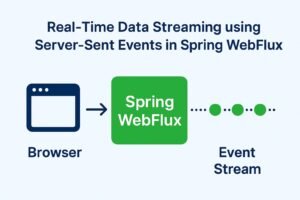
Enhancing Web Apps with Server-Sent Events

The Age of Real-Time Apps <> While exploring and experimenting with Spring Web Flux, I stumbled upon an interesting feature called Server-Sent Events (SSE) (rather an HTML5 standard) . Although I haven’t had the opportunity to use SSE in my professional projects yet, it immediately caught my attention — both for how it works and the real-time advantages it offers. I was curious to understand where it fits as a component within a modern, real-time application architecture. Here’s a summary of…
Read MoreEnhancing Web Apps with Server-Sent Events

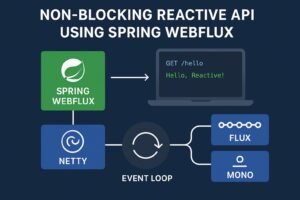
From Monolithic to Microservices: Embrace Spring WebFlux

Monolithic to Microservices Till the late 2000s, I had witnessed and worked extensively on monolithic applications — the era when a single server hosted the entire system. Some of the popular choices for these central servers were WebLogic, WebSphere, and JBoss. However, that age has long passed. Such architectural choices eventually failed to scale, lacked fault tolerance, and struggled to deliver high availability — paving the way for modern, distributed, and cloud-native architectures. In the modern world of microservices, cloud-native architectures,…

Read MoreFrom Monolithic to Microservices: Embrace Spring WebFlux

Reactive Programming In Modern Software Systems

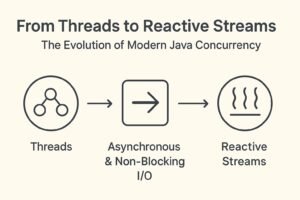
From Threads to Reactive Streams Modern software systems are increasingly expected to deliver high responsiveness, scalability, and efficiency in environments that are distributed, data-intensive, and constantly connected. Traditional thread-based concurrency models, often become inadequate although they are foundations, as applications scale to handle millions of concurrent users or data streams. Java, one of the most widely adopted programming languages for backend and enterprise systems, has continuously evolved to meet these demands—from classic multithreading to asynchronous I/O and finally to reactive programming.…

Read MoreReactive Programming In Modern Software Systems